Tiny house living means every square foot counts, including the space above your head. Lofts aren’t just bonus areas: they’re essential real estate in homes under 400 square feet. Whether it’s a sleeping nook, storage zone, or multi-purpose platform, a well-designed loft transforms vertical space into functional living area without expanding the footprint. The challenge is making that space work hard while staying safe, comfortable, and accessible. This guide covers bedroom layouts, storage hacks, access solutions, and design ideas that help tiny house owners squeeze maximum utility from their overhead square footage.
Table of Contents
ToggleKey Takeaways
- Tiny house loft ideas solve the space constraint problem by creating dedicated sleeping or storage zones without expanding the footprint, allowing homes under 400 square feet to maximize functionality.
- Proper ceiling height (at least 3 feet for sleeping per IRC codes), ventilation through gable windows or fans, and low-profile mattresses (6-8 inches) are essential for comfort in compact loft bedrooms.
- Smart storage solutions like lift-up beds with drawers, under-loft closets, railing-mounted baskets, and overhead cargo nets help tiny house owners eliminate clutter and avoid expensive offsite storage units.
- Loft access options range from space-saving fixed ladders (12-16 inches deep) to alternating-tread stairs and full staircases with integrated storage drawers, with safety guardrails required at 36 inches minimum.
- Proper lighting (recessed LED pucks or strip lights) and ventilation systems (gable windows, DC fans, roof vents) prevent lofts from becoming hot, dark, and stuffy, while separate circuits keep main floor residents comfortable.
- Multi-purpose loft designs beyond bedrooms—including office nooks, reading lounges, or kids’ play areas—add significant square footage and flexibility to tiny homes when headroom allows.
Why Tiny House Lofts Are Essential for Small Space Living
Lofts solve the biggest problem in tiny houses: lack of dedicated zones. A standard tiny house on a trailer measures 8.5 feet wide by 20–30 feet long, giving roughly 170–255 square feet per floor. Without a loft, owners sacrifice a bedroom or cram sleeping quarters into the main living area. Adding a loft creates a separate sleeping or storage zone without consuming floor space.
Most tiny house lofts sit 3.5–4.5 feet below the ceiling, with 2.5–4 feet of headspace above the mattress. That’s tight but workable for sleeping. The International Residential Code (IRC) Appendix Q for tiny houses allows loft ceiling heights as low as 3 feet in areas used for sleeping, provided the loft meets egress and guardrail requirements. Always check local jurisdiction, some areas follow IRC, others have stricter rules.
Lofts also improve energy efficiency. Warm air rises, so loft sleeping areas stay warmer in winter. In summer, adding a ceiling fan or operable window in the gable helps exhaust hot air. Owners of small homes often apply creative storage strategies to reduce clutter and increase livability, and lofts play a key role in that approach.
Structurally, lofts add minimal weight if built with 2×6 or 2×8 joists on 16-inch centers, spanning the width of the trailer frame. Use joist hangers rated for the load, and consider consulting a structural engineer if the loft will hold more than a mattress and two adults, especially if adding built-in storage or a desk.
Bedroom Loft Designs That Maximize Comfort and Style
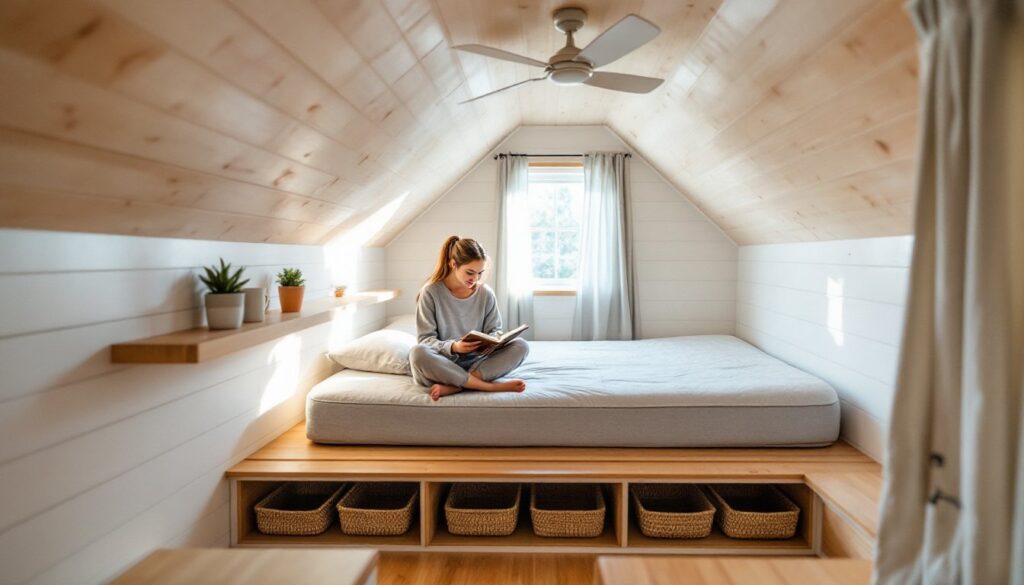
A loft bedroom needs more than a mattress on plywood. Comfort starts with the right mattress thickness. A standard 10–12 inch mattress eats up precious headroom: many tiny house owners opt for 6–8 inch memory foam or hybrid mattresses to preserve sitting height. Measure vertical clearance before buying, sitting upright should feel natural, not cramped.
Bedding and ventilation matter more in lofts than ground-floor bedrooms. Without good airflow, body heat and humidity build up fast. Install a small 12-volt DC fan or a gable vent at the peak to pull warm air out. Some builders add a ridge vent along the roofline for passive ventilation. Windows in the gable end (even small ones) provide cross-breeze and emergency egress, IRC Appendix Q requires at least one operable window or door per loft for emergency escape.
Built-in side tables and ledges keep phones, glasses, and books within reach without taking floor space. A shallow shelf running along the loft’s perimeter, 4–6 inches deep, works well. Add LED strip lighting underneath for reading without harsh overhead lights. Designers focused on modern living spaces often incorporate flexible lighting to create ambiance in tight quarters.
Privacy becomes an issue in open-plan tiny houses. Hanging a curtain or sliding barn door at the loft entrance blocks sightlines from below. Use lightweight materials, canvas, linen, or even a tension rod with fabric panels.
Low-Ceiling Loft Solutions
Lofts with under 3 feet of headroom work only for sleeping, but smart design makes them livable. Position the mattress lengthwise along the longest wall to maximize usable area. A Japanese-style futon or floor mattress (4–6 inches thick) gains a few extra inches of clearance.
Built-in side storage cubbies along the loft perimeter hold books, devices, and clothes without requiring shelving that drops the ceiling further. Cut rectangular openings into the loft floor framing (between joists) and drop in wooden boxes or fabric bins. These double as organizers and reduce visual clutter.
Some owners skip the mattress frame entirely, laying a tatami mat or thick rug directly on the loft decking for insulation and comfort. If going this route, use ¾-inch plywood or tongue-and-groove OSB for the loft floor, it’s rigid enough to prevent flexing and quieter underfoot than thinner materials.
Creative Storage Ideas for Loft Spaces
Storage in a tiny house loft isn’t optional, it’s survival. Start with the space under the loft. The area between the main floor and loft joists (typically 6.5–7 feet of clearance) fits a closet, pantry, or washer-dryer stack. Frame out a closet with 2×3 studs to save an inch of depth compared to 2×4s.
Inside the loft, build storage into the bed platform. Lift-up storage beds (using gas struts or piano hinges) provide access to large bins or drawers beneath the mattress. If headroom allows, add pull-out drawers along the sides, use full-extension drawer slides rated for at least 75 pounds per pair.
Overhead storage nets or cargo netting mounted to the loft rafters keep lightweight items (blankets, pillows, off-season clothes) accessible but out of the way. Use paracord or bungee cords to secure the net to eye hooks screwed into the rafters. Don’t overload, netting is for soft goods, not books or tools.
Loft railings can double as storage. Instead of simple 2×4 rails, use horizontal slat railings with 4–6 inches of depth behind them. Slide shallow baskets or magazine holders into the gaps. Another option: perforated metal panels or pegboard mounted to the inside of the railing, creating a customizable hanging system for bags, hats, or charging cables.
Some builders install built-in cabinetry at the foot of the loft bed, creating a small wardrobe or bookshelf accessible from below. Use pocket doors or sliding panels to keep the look clean. Owners pursuing cost-cutting living arrangements often rely on these DIY storage solutions to avoid renting offsite units.
Loft Ladder and Staircase Options for Easy Access
Access to a tiny house loft is a daily friction point. Ladders save space but aren’t practical for everyone. Stairs are safer and more comfortable but eat up 15–25 square feet of floor area.
Ladders come in three styles: fixed vertical, fixed angled, and removable. A fixed vertical ladder (rungs perpendicular to the wall) uses the least space, about 12–16 inches of floor depth, but it’s hard to climb with an armful of laundry or in the dark. An angled ladder (65–75 degrees) is easier to navigate and still only needs 18–24 inches of floor space. Use 1.25-inch dowels or metal pipe for rungs, spaced 10–12 inches apart. Secure the ladder to wall studs with lag bolts or heavy-duty brackets.
Alternating-tread stairs (also called ship’s ladders) offer a middle ground. They need 24–30 inches of width and 50–60 inches of run, but they’re far easier to climb than a ladder. Each step alternates left and right, creating a steep but manageable ascent. Build them with 2×10 or 2×12 treads for strength. These are common in tiny houses featured on small-space design sites focused on maximizing function.
Full staircases with standard 7-inch rise and 10-inch tread dimensions are the most comfortable but require 8–10 feet of linear floor space. To justify that footprint, integrate storage. Each step can be a drawer or lift-top box. Use full-extension slides rated for 100 pounds and soft-close hinges if the steps open upward. The space under the staircase fits a closet, pantry, or small desk nook.
Safety note: IRC requires guardrails at least 36 inches high around loft edges. Stair handrails should be 34–38 inches above the nosing. Even if your jurisdiction doesn’t enforce these codes, they’re good practice, especially for resale.
Multi-Purpose Loft Designs Beyond the Bedroom
Not every loft has to be a bedroom. A second loft (if ceiling height allows) or a redesigned primary loft can serve as an office, lounge, or kids’ play area.
Office lofts work best with a low-profile desk (24–30 inches deep) positioned against the gable wall. Add a fold-down desktop or wall-mounted bracket desk to save space when not in use. Run electrical and Ethernet during framing, pulling cable after drywall is a hassle. Use 12/2 Romex for outlets (code allows one circuit for lighting and receptacles in a tiny house under 400 sq ft, but check local NEC adoption). Keep a small desk lamp and task lighting instead of relying on overhead fixtures.
Lounge lofts turn the space into a reading nook or entertainment zone. Add built-in bench seating with cushions, a small bookshelf, and a wall-mounted tablet or monitor. If headroom allows (4+ feet of clearance), this becomes a surprisingly comfortable hangout. Install a ceiling-mounted projector for a tiny home theater.
Kids’ lofts need extra safety measures: taller guardrails (42 inches), reinforced flooring (kids jump), and impact-resistant finishes. Avoid top-bunk beds for children under 6. Use soft flooring like foam tiles or thick rugs and keep toys in labeled bins to reduce clutter.
Some owners skip lofts entirely and build a flexible living layout on a single level, especially if accessibility is a priority. But for those who can navigate stairs or ladders, a second loft adds significant square footage to the home.
Lighting and Ventilation Tips for Tiny House Lofts
Lofts get hot, dark, and stuffy without proper lighting and airflow. Address both from the start, retrofitting is harder once walls are closed.
Lighting: Overhead lights in low lofts are a head hazard. Use recessed LED puck lights (2–3 inches deep) installed in the ceiling or LED strip lights along the perimeter edge of the loft floor. Strips mounted under the loft railing provide ambient light without glare. Opt for warm white (2700–3000K) to keep the space cozy. Add a dimmer switch so the loft can shift from task lighting (getting dressed) to ambient (winding down).
Wire loft lighting on a separate circuit or switch from the main floor so occupants below aren’t forced into darkness when someone’s asleep in the loft. Many modern tiny home designs incorporate smart lighting systems with app control, useful if the switch is at the bottom of the stairs.
Ventilation: A loft without airflow becomes a heat trap. The simplest fix is a gable-end window (operable casement or awning style). Even a 24×24-inch window makes a difference. Pair it with a 12-volt DC fan (4–6 inch diameter) wired to a solar panel or the house battery. In hot climates, add a roof vent fan (MaxxFan, Fantastic Vent) directly above the loft, these pull hot air out and can run on low power overnight.
In winter, reverse the fan direction or crack the loft window to prevent condensation. Warm, moist air from breathing condenses on cold surfaces (windows, metal roofing) and leads to mold. A small dehumidifier (mini electric or rechargeable silica unit) helps in humid climates.
Safety: Install a smoke detector in or near the loft. Battery-powered units work, but hardwired interconnected detectors (required by code in most jurisdictions) are safer, if one sounds, they all sound. Add a carbon monoxide detector if you have a propane heater or stove.