A beautiful front yard shouldn’t mean spending every weekend weeding, watering, and deadheading. The right plant choices and a smart setup can deliver year-round color and texture with minimal effort. Low-maintenance flower beds combine hardy perennials, strategic hardscaping, and simple irrigation to cut your yard work in half while boosting curb appeal. Whether you’re working with a small strip along the walkway or a large corner lot, these ideas help homeowners create a front yard that looks intentional, not neglected.
Table of Contents
ToggleKey Takeaways
- Low-maintenance flower bed ideas thrive on hardy perennials like daylilies, black-eyed Susans, and coneflowers that return annually without replanting and tolerate drought and poor soil conditions.
- Combining evergreen shrubs and ornamental grasses creates year-round structure and visual interest, reducing the flat appearance of traditional flower beds during off-season months.
- A 2–3 inch layer of mulch combined with living ground covers like creeping thyme or ajuga can cut weeding maintenance by half while conserving soil moisture and moderating temperature.
- Installing a simple drip irrigation system with a timer automates watering, reduces water consumption by 30–50%, and eliminates the uneven coverage of hand-watering methods.
- Design your front yard flower beds to match your home’s architectural style—whether cottage-style with boxwood, prairie with native grasses, or modern minimalist with geometric edging and monochromatic plantings.
- A well-designed low-maintenance flower bed requires attention only three to four times per year, making it ideal for busy homeowners while boosting curb appeal and protecting your landscaping investment.
Why Low-Maintenance Flower Beds Are Perfect for Front Yards
Front yards face unique challenges: they’re visible to the neighborhood, exposed to street traffic and road salt, and often the first thing guests see. Unlike backyard gardens where you can experiment and hide mistakes, the front demands consistency.
Low-maintenance beds solve this by relying on plants that tolerate neglect, weather extremes, and variable sunlight. They reduce the need for weekly watering, fertilizing, and pest control, tasks that become unrealistic during busy seasons or travel. A well-designed bed might need attention just three to four times per year: spring cleanup, midsummer mulch refresh, fall cutback, and occasional weeding.
This approach also protects your investment. Perennials and shrubs cost more upfront than flats of annuals, but they return year after year without replanting. Mulch and ground covers suppress weeds and retain soil moisture, cutting water bills and reducing runoff. For homeowners in HOA neighborhoods or those planning to sell, a tidy, established flower bed signals care without the curb clutter of high-maintenance landscapes.
Choose Hardy Perennials Over Annuals
Annuals like petunias and impatiens deliver instant color, but they die with the first frost and need replanting every spring. Perennials establish deep root systems, come back each year, and often spread to fill gaps, cutting your planting work to nearly zero after the first season.
Top low-maintenance perennials for front beds:
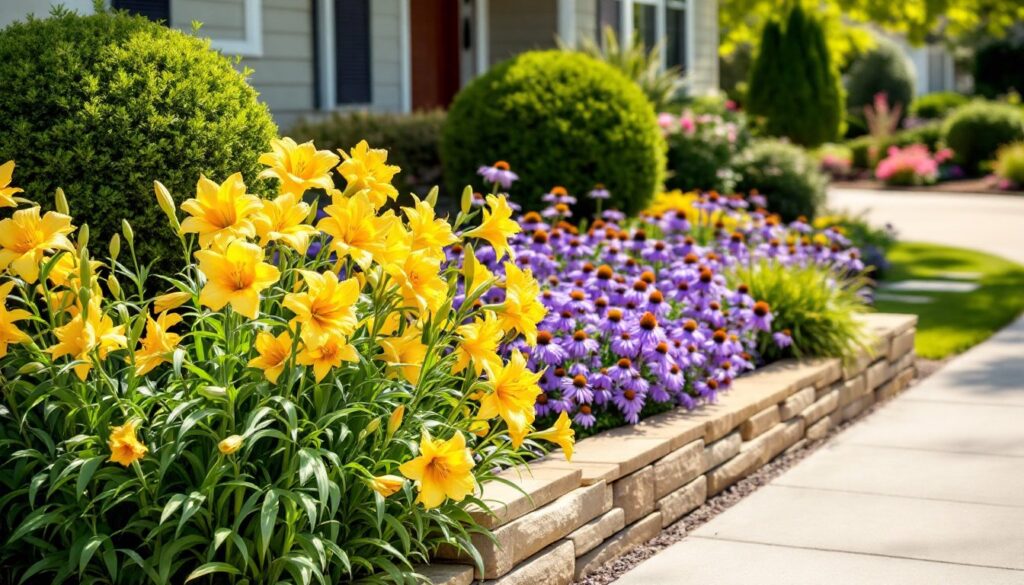
- Daylilies (Hemerocallis): Bloom for weeks in summer, tolerate drought and clay soil, require no deadheading. Available in dozens of colors.
- Black-eyed Susans (Rudbeckia): Native to most of the U.S., drought-tolerant once established, self-seed modestly without becoming invasive.
- Coneflowers (Echinacea): Attract pollinators, handle heat and dry spells, and look good even after the petals drop if you leave the seed heads for winter interest.
- Hostas: Thrive in shade, nearly indestructible in zones 3–9, and offer foliage variety from chartreuse to deep blue-green.
- Sedum (Stonecrop): Succulent-like leaves store water, making them ideal for hot, sunny spots with poor soil.
Plant perennials in spring or early fall when temps are moderate. Space them according to their mature spread (check the tag, most expand significantly by year two). Water deeply twice a week for the first month, then taper off. Once roots are down 12–18 inches, most perennials survive on rainfall alone in temperate climates.
Avoid heavy feeders like dahlias or delphiniums that need staking, regular fertilization, and winter lifting. Stick with natives or regionally adapted plants, your local extension office provides free lists based on USDA hardiness zone and soil type.
Incorporate Evergreen Shrubs and Ornamental Grasses
Perennials die back in winter, leaving bare soil and a flat profile. Evergreen shrubs and ornamental grasses fill that gap, providing year-round structure and reducing the visual “off-season” slump.
Evergreen shrubs for foundation beds:
- Boxwood (Buxus): Dense, rounded form: tolerates shearing: hardy in zones 5–9. Plant dwarf varieties like ‘Green Gem’ for 2–3 ft. height.
- Dwarf Alberta Spruce (Picea glauca ‘Conica’): Compact conical shape, no pruning needed, grows 6–8 inches per year to a max of 10–12 ft. over decades.
- Inkberry Holly (Ilex glabra): Native, handles wet or dry soil, dark green foliage, no spines. ‘Compacta’ stays under 4 ft.
Ornamental grasses for texture and movement:
- Fountain Grass (Pennisetum): Arching foliage, feathery plumes in late summer, clumps stay 2–3 ft. wide. Cut back to 4–6 inches in early spring.
- Blue Fescue (Festuca glauca): Compact, steel-blue tufts, drought-tolerant, evergreen in mild climates.
- Switchgrass (Panicum virgatum): Native prairie grass, upright habit, turns gold in fall, provides winter interest until March.
Grasses require almost no care, just one annual cutback before new growth emerges. Use hedge shears or a string trimmer: don’t cut below the crown. Shrubs may need light shaping every few years, but slow-growing evergreens like yew and arborvitae can go 5–10 years between trims if you choose the right cultivar for the space.
Combine grasses and shrubs as anchors at bed corners or intervals, then fill around them with perennials. This layered approach, often called the “bones” of the garden, keeps the bed looking intentional even when flowers aren’t in bloom.
Use Mulch and Ground Covers to Reduce Weeding
Bare soil is an invitation for weeds. A 2–3 inch layer of mulch or a living ground cover blocks sunlight, conserves moisture, and moderates soil temperature, cutting maintenance by half.
Mulch options:
- Shredded hardwood bark: Decomposes slowly, knits together to resist washout, dyed options (brown, black, red) last 1–2 seasons before fading.
- Pine bark nuggets: Larger chunks (1–2 inches), last longer than shredded, but can float away in heavy rain if bed has slope.
- Cypress or cedar: Naturally pest-resistant, pleasant scent, pricier but lasts 2–3 years without refresh.
Apply mulch in late spring after soil warms and perennials emerge. Keep it 2–3 inches from plant stems to prevent rot and rodent nesting. Spread evenly with a garden rake. One cubic yard covers roughly 100 square feet at 3 inches deep, measure your bed and order accordingly.
Living ground covers for fill areas:
- Creeping Thyme (Thymus serpyllum): Fragrant, tolerates foot traffic, purple blooms in summer, evergreen in zones 5–9.
- Ajuga (Bugleweed): Spreads quickly, blue or purple flower spikes, thrives in shade, can be aggressive, use where you want full coverage.
- Creeping Phlox (Phlox subulata): Mat-forming, cascades over bed edges, covered in pink, white, or purple blooms in spring.
Ground covers work well in large beds or slopes where mulch would erode. Plant plugs on 12–18 inch centers: they’ll fill in within one season. Water until established, then ignore them.
Combine mulch and ground covers: use mulch in high-visibility areas near the walk, and plant ground covers in the back or sides where they can spread without smothering prized perennials.
Install a Simple Drip Irrigation System
Hand-watering a front bed eats time and often results in overwatering near the hose and underwatering at the far end. A drip irrigation system delivers consistent moisture directly to root zones, cutting water use by 30–50% and freeing you from hose duty.
Basic drip setup (no permit required, DIY-friendly):
- Connect to an outdoor faucet via a backflow preventer (required by most municipalities to prevent contamination of potable water).
- Run ½-inch polyethylene mainline tubing along the back edge of the bed, secured with landscape staples every 2–3 ft.
- Insert ¼-inch distribution tubing at each plant using barbed tee fittings or punch-in emitters.
- Add emitters (1–2 GPH flow rate) at the base of each perennial or shrub. Adjust emitter count based on plant size: small perennials get one, large shrubs get three spaced around the root zone.
- Cap the end of the mainline with a figure-8 closure or end clamp.
- Attach a battery-operated timer at the faucet to automate watering. Set it for 20–30 minutes, 2–3 times per week in summer: reduce frequency in spring and fall.
Tools and materials:
- Poly tubing cutter or utility knife
- Hole punch tool for emitter placement
- Teflon tape for hose threads
- Total cost: $50–$120 for a 50–100 sq. ft. bed, depending on emitter count
Test the system before mulching. Turn on the water and check for leaks at fittings and even flow from emitters. Adjust as needed. Once confirmed, lay mulch over tubing to hide it and protect from UV degradation.
Drip irrigation shines during vacations or dry spells. Many timers sold at home improvement retailers allow multiple daily cycles and rain delay features. Pair with a rain sensor (optional, ~$20) to skip watering after storms and save more water.
Design Ideas for Different Front Yard Styles
A low-maintenance bed doesn’t mean a cookie-cutter look. Tailor plant choices and layout to your home’s architecture and regional climate for a cohesive, intentional design.
Cottage-style beds (traditional, colorful):
- Mix daylilies, coneflowers, and black-eyed Susans with low boxwood hedges for structure.
- Edge with natural stone or brick for a soft, informal border.
- Add a climbing rose on a simple obelisk or arbor near the entry (choose disease-resistant varieties like ‘Knock Out’ to minimize spraying).
Prairie or native beds (naturalistic, eco-friendly):
- Use switchgrass, little bluestem, and native perennials like blazing star (Liatris) and asters.
- Skip formal edging: let grasses spill onto lawn or hardscape.
- Mulch with shredded leaves or let plants self-mulch with fallen foliage, this mimics natural prairie conditions and feeds soil biology.
Xeriscape beds (arid climates, water conservation):
- Feature sedum, yucca, ornamental sage (Salvia), and Russian sage (Perovskia).
- Use decomposed granite or pea gravel instead of organic mulch to reflect heat and prevent rot.
- Group plants by water needs: place drought-tolerant species farthest from irrigation.
Shade beds (north-facing or under trees):
- Plant hostas, ferns, astilbe, and hellebores for color and texture without sun.
- Use lighter-colored mulch (cypress or pine) to brighten dim areas.
- Avoid placing beds directly under shallow-rooted trees like maples, roots compete for water and nutrients.
For region-specific ideas and plant pairings that thrive in southern climates, resources like Southern Living offer detailed garden plans adapted to heat and humidity. Match your bed depth to plant mature size: 18–24 inches deep for perennials, 3–4 feet for shrubs, to avoid crowding walkways or siding.
Modern Minimalist Flower Beds
Clean lines, limited color palettes, and bold repetition define modern minimalist beds. This style works especially well with mid-century and contemporary homes.
Design principles:
- Repetition over variety: Plant the same species in odd-numbered groups (3, 5, 7) rather than one of everything.
- Geometric edging: Use steel, aluminum, or composite edging for crisp, straight borders. Install flush with grade for a seamless lawn-to-bed transition.
- Monochromatic or two-tone plantings: Stick to greens and whites (hostas, white coneflowers, variegated grasses) or greens and purples (lavender, catmint, purple fountain grass).
- Hardscape accents: Incorporate large river rock, concrete pavers, or Corten steel planters as focal points.
Low-maintenance plant combos for modern beds:
- Tier 1 (front, 6–12 inches): Blue fescue or mondo grass in a continuous ribbon
- Tier 2 (middle, 18–24 inches): Karl Foerster feather reed grass or ‘Annabelle’ hydrangea (reblooming types need less deadheading)
- Tier 3 (back, 3–4 feet): Upright yews or sky pencil holly for vertical accent
Keep mulch uniform and top-dress annually to maintain the crisp, uncluttered look. Avoid flowering plants that drop petals or seed heads unless you’re committed to weekly tidying, modern minimalist beds rely on foliage and form, not constant bloom.