Tiny house kitchens demand ruthless efficiency. With often less than 40 square feet to work with, every drawer, appliance, and wall surface needs to earn its keep. The challenge isn’t just fitting everything in, it’s creating a space that’s genuinely functional for daily cooking, not just showroom-pretty.
The good news? Decades of RV design, galley kitchens, and compact living have produced battle-tested strategies that work. The following ideas cover layout, storage, appliances, and visual tricks that make small kitchens perform like spaces twice their size.
Table of Contents
ToggleKey Takeaways
- Galley and L-shaped layouts dominate tiny house kitchen designs because they maximize workflow efficiency within 3–4 feet between work zones, compared to standard 4–9 feet in larger kitchens.
- Vertical storage strategies, including floating shelves, magnetic strips, and pegboard panels, can reclaim up to 30% more usable space in kitchens under 50 square feet.
- Compact 24-inch ranges, countertop convection ovens, and combination appliances like multi-cookers replace multiple full-sized appliances while consuming far less space and energy.
- Shallow 18-inch-deep cabinets with pull-out drawers and drawer-style storage maximize accessibility and usable storage without consuming excessive floor space.
- Light-colored cabinets, glass-front doors, mirrored backsplashes, and consistent flooring create the visual illusion of a larger kitchen and improve the sense of openness.
- Fold-down counters, pull-out cutting boards, and rolling carts provide flexible prep surfaces that transform small kitchens into fully functional cooking spaces without permanent footprint impact.
Smart Layout Strategies for Tiny House Kitchens
The kitchen work triangle, sink, stove, fridge, still applies in tiny spaces, but the distances shrink to 3-4 feet between points instead of the standard 4-9 feet. This tighter layout actually improves efficiency when designed correctly.
Galley layouts dominate tiny house kitchens for good reason. Two parallel runs of counter and storage, typically 3-4 feet apart, create a natural workflow. One side handles wet tasks (sink, dish rack), the other dry (prep, cooking). This setup fits kitchens as narrow as 6 feet wall-to-wall.
L-shaped configurations work when one wall is available for plumbing and the adjacent wall can hold cooking equipment. This opens up sightlines and makes the kitchen feel less tunnel-like. Corner space often gets wasted, though, lazy Susans or pull-out corner units recover some of that dead zone.
Single-wall kitchens save the most floor space but sacrifice counter area. They work best when paired with a fold-down prep surface or rolling cart. If going single-wall, keep the sink in the middle with the cooktop and fridge on either side to minimize drips across the counter when moving between tasks.
One often-overlooked detail: appliance ventilation. Range hoods in tiny spaces need to vent outside, not recirculate. Grease and moisture have nowhere to go in a 200-square-foot house. A slim 24-inch hood with a 200+ CFM rating exhausts properly without dominating the wall. Check local codes, some jurisdictions require ducted ventilation in all new kitchens, regardless of size.
Space-Saving Storage Solutions That Actually Work
Standard base cabinets run 24 inches deep, but tiny kitchens often use 18-inch-deep cabinets to save floor space without losing much storage. Shallower cabinets also mean items don’t get lost in the back, everything stays visible and reachable.
Drawer stacks beat cabinet doors in tight quarters. Pull-out drawers let someone access contents without crouching or moving out of the way. A stack of four drawers (varying from 4 to 10 inches tall) in a 30-inch-wide base cabinet holds more usable storage than a single shelf-and-door setup.
Inside cabinets, pull-out organizers multiply capacity. A pull-out spice rack 3 inches wide fits between a stove and wall. Pull-out trash and recycling bins hide waste without eating counter space. Under-sink pull-outs work around plumbing to organize cleaning supplies on tiered trays.
Toe-kick drawers recover the 4-inch-tall, 3-inch-deep space under base cabinets. They’re ideal for flat items: baking sheets, cutting boards, placemats. The drawer faces match the cabinet finish, keeping the look cohesive.
Integrating storage tactics from larger projects helps tiny house owners think modular. Custom-fit inserts for utensils, knife blocks, and lid organizers turn every drawer into dedicated real estate.
Vertical Storage and Wall-Mounted Options
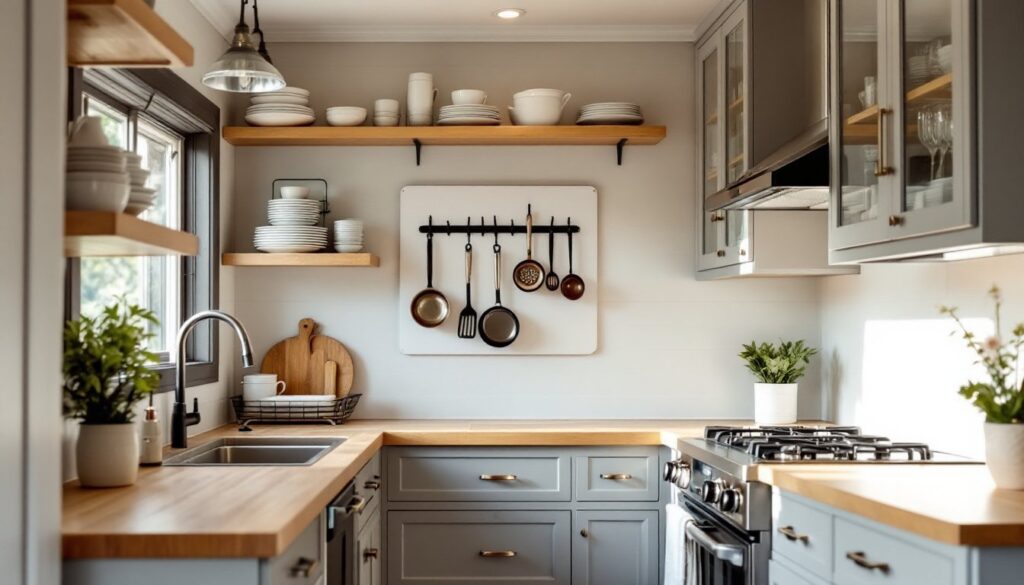
Wall space above counters is prime territory. Open shelving between 12-18 inches deep holds everyday dishes, glassware, and pantry staples. Floating shelves on heavy-duty brackets (rated for 50+ pounds) mount directly to studs. Skip the drywall anchors, vibration from closing doors will loosen them over time.
Magnetic knife strips and hanging rails keep tools off counters. A 16-inch stainless steel magnetic strip holds six knives. S-hooks on a rail under upper cabinets hang mugs, measuring cups, or utensils.
Pegboard panels offer flexible tool storage. A 2×3-foot pegboard painted to match the kitchen holds pots, pans, and lids on repositionable hooks. Pegboard works best on an inside wall, not an exterior wall where temperature swings can cause warping.
Ceiling-mounted pot racks work if ceiling height allows (minimum 7 feet clearance to avoid head-knocking). A 24×36-inch rack holds 8-10 pots and pans overhead. Make sure it’s anchored into ceiling joists, not just drywall, cookware is heavy.
According to design resources like Apartment Therapy, vertical storage can reclaim up to 30% more usable space in kitchens under 50 square feet. That’s the difference between cramped and functional.
Compact Appliances and Multi-Functional Tools
Standard 30-inch ranges don’t fit most tiny house kitchens. 24-inch ranges with four burners and a small oven run on propane or electric and drop into the same footprint as a dishwasher. Brands like Summit and Avanti make models specifically for RVs and small homes. An 18-inch range (two burners, small oven) works for solo or couple living but gets tight when cooking multi-dish meals.
Cooktop-only installations open up storage below. A two-burner induction or propane cooktop sits on the counter (or flush-mounts into it), leaving room underneath for drawers or a slide-out cutting board. Pair it with a countertop convection oven (holds a 12-inch pizza, roasts a chicken) for baking. This combo uses less energy than a full range.
Refrigerators shrink, too. Apartment-sized fridges at 24 inches wide and 10-12 cubic feet handle weekly groceries for two people. For smaller needs, a 4.5-cubic-foot compact fridge fits under the counter. Top-freezer models are more energy-efficient than side-by-side.
Drawer-style fridges and freezers (like those in boats) fit into base cabinets and pull out like drawers. A 24-inch fridge drawer holds about 5 cubic feet. They cost more upfront but maximize counter space since nothing sits on top.
Combination appliances save room. A microwave-convection oven combo handles reheating, baking, and browning in one unit. Instant Pots and multi-cookers replace slow cookers, rice cookers, and pressure cookers. A single 6-quart unit does the work of three appliances.
Skip the dishwasher unless it’s a countertop model (holds 4-6 place settings, connects to the sink faucet). Most tiny house dwellers hand-wash in a deep farmhouse sink with a drying rack overhead. If counter space is tight, a fold-down drying rack mounted to the wall above the sink keeps dishes off surfaces.
Tools matter as much as appliances. Nesting bowls, collapsible colanders, and stackable measuring cups take up a fraction of the drawer space. Magnetic measuring spoons stick to the side of the fridge. Every item should serve multiple purposes or collapse when not in use.
Design Tricks to Make Your Kitchen Feel Bigger
Light-colored cabinets and walls reflect light, making small spaces feel airier. White, light gray, or pale wood tones are standard, but soft greens and blues work too, just avoid anything darker than a mid-tone. Matte finishes hide fingerprints better than gloss but don’t reflect as much light. Semi-gloss strikes a balance.
Glass-front cabinet doors or open shelving trick the eye into seeing depth instead of a solid wall of cabinetry. One or two upper cabinets with glass panes (or removed doors entirely) lighten the visual load. This works best for neatly organized dish storage, clutter behind glass makes the space feel messy.
Mirrors aren’t just for bathrooms. A mirrored backsplash behind the stove or sink doubles the visual space and reflects light from windows. Use mirror tiles or a single sheet of mirror cut to size. Clean it with glass cleaner, not abrasive scrubs, to avoid scratching.
Under-cabinet LED strip lighting brightens counters without taking up space. Warm white LEDs (2700-3000K) feel more natural than cool white in kitchens. A 3-foot strip uses about 10 watts and runs off a plug-in transformer. Hardwired kits exist but may require an electrician if not comfortable with 120V wiring.
Consistent flooring that runs from the kitchen into adjacent areas makes the whole space feel larger. If the living area has light oak laminate, carry it into the kitchen rather than switching to tile. The unbroken sightline stretches perceived square footage.
Similar principles appear in broader renovation strategies where visual continuity drives the sense of openness. Small details like matching hardware finishes (all brushed nickel or matte black) across cabinets, faucets, and light fixtures also unify the look.
Creative Counter Space and Prep Area Ideas
Counter space is the scarcest resource in a tiny kitchen. Standard countertop depth is 25 inches (24-inch cabinet plus 1-inch overhang), but some tiny house builders go narrower, 20 or 22 inches, to save floor space. That’s workable for light prep but tight for rolling dough or carving a roast.
Fold-down counters add surface area on demand. A 24-inch-wide by 18-inch-deep fold-down section mounts to the wall with heavy-duty hinges and a drop-leg support. When not in use, it folds flat against the wall. Finish it in the same material as the main counter (butcher block, laminate, or solid surface) so it blends in.
Pull-out cutting boards hidden in a drawer or cabinet slide out over an open drawer below for stability. A 16×20-inch board gives enough room for chopping vegetables. Some designs include a catch bin underneath for scraps. Make sure the drawer slides are rated for at least 75 pounds to handle the weight plus downward pressure from cutting.
Rolling carts act as movable islands. A 24×18-inch cart with a butcher block top, one shelf, and locking casters stores in a corner or next to the fridge, then rolls out for extra prep space. When cooking is done, it can double as a serving station or bar cart. Look for models with a towel bar or hooks on the side for hanging utensils.
Over-the-sink cutting boards rest on the sink rim, covering the basin and creating a temporary work surface. These work best with undermount sinks where the counter edges are smooth and level. A 24-inch board bridges a standard single-bowl sink. Don’t use it while the sink is full, the board can slip.
Some tiny house owners install a slide-out counter extension from the end of a base cabinet run. A 12-inch-deep by 24-inch-wide surface slides out on full-extension drawer glides when needed, then tucks away. This requires a 2-3 inch gap next to the cabinet and glides rated for side-load pressure.
Design inspiration from sources like Remodelista highlights how even 12 extra inches of counter can transform daily cooking routines. For those tackling broader kitchen updates, integrating flexible surfaces early in the design phase saves headaches later.
Conclusion
Tiny house kitchens aren’t about compromise, they’re about precision. Every drawer, every inch of wall, and every appliance choice has to work harder than in a full-sized home. But when layout, storage, and tools align, a 40-square-foot kitchen can handle everything from weeknight dinners to holiday baking. The key is designing with intention, not cramming in miniature versions of a suburban kitchen and hoping for the best.